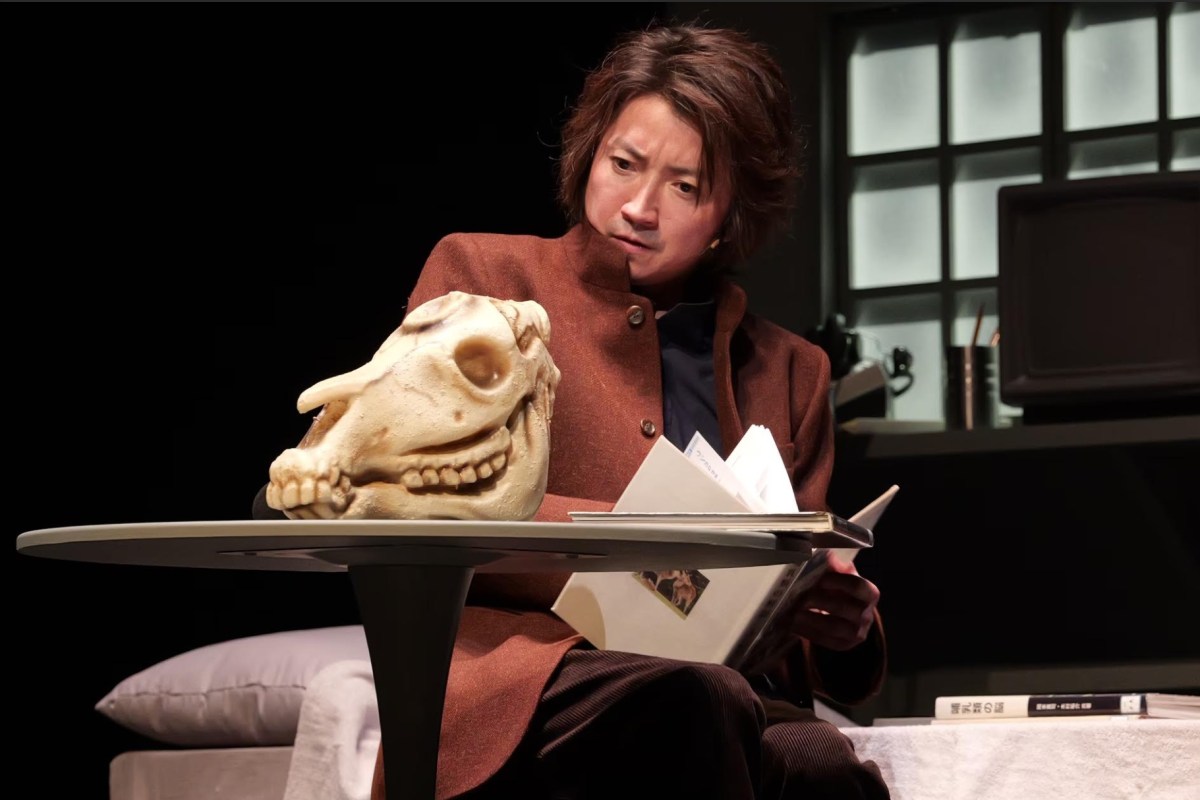
Haruki Murakami’s fiction occupies a special place where the everyday and the inexplicable coexist, where loneliness lurks beneath the surface of modern life, and one’s imagination can be an unreliable witness. Translating his sprawling, multi-layered novels to an effective production for the stage is no small undertaking then.
With the European premiere of End of the World and Hard-Boiled Wonderland, director and choreographer Philippe Decouflé achieves something really memorable. This is a production that captures Murakami’s fantastical imagery and respects its distinctive tone of wry humour, dreamlike strangeness and pervasive melancholy.
End of the World review – quick links
Murakami’s strange worlds
Adapted by Ako Takahashi from Murakami’s 1985 novel, a work of more than 400 pages, this delightful production unfolds across two parallel worlds.
In one, Watashi (Tatsuya Fujiwara) navigates a bleak, technologically advanced Tokyo, where he becomes embroiled in a mysterious conspiracy. In the other world, Boku inhabits a walled town of dreams, populated by gorgeous balletic unicorns and people stripped of their shadows. Never again will you take your shadow for granted!
As the narratives intertwine, questions of memory, identity and consciousness emerge from the bewildering abundance of incident and imagery. As they say, how does it feel to be lost inside a labyrinth of memories?
Decouflé doesn’t try to explain this world; he understands that it must be entered on its own terms. The profusion of ideas is exhilarating and a little overwhelming for people who don’t know the book. There’s a professor who studies skulls to recover the sounds of past experiences; strange creatures inhabiting the underground; and the separation of a person from their shadow becomes the starting point for a quietly disturbing meditation on what makes us human.
Staging the surreal
The production’s aesthetic feels entirely in keeping with Murakami’s unique imaginative logic, in which the surreal is accepted in the same way as an everyday encounter.
The stage becomes a constantly shifting landscape of theatrical invention. K Ishihara’s set design, Taiki Ueda’s projections and Yukiko Yoshimoto’s lighting create worlds that are both vividly realised and yet remain tantalisingly elusive.
The theatrical machinery of set and lighting is often playfully exposed, inviting us to delight in the artifice. Decouflé’s choreography is magnificent, combining the elegance of ballet with astonishing athleticism as dancers transform into underground creatures that tumble and cartwheel with uncanny agility.
Most enchanting are the unicorns, whose stylised, almost weightless movements bring an improbable herd of mythical animals to life. They are superb. The dance in the rain, with umbrellas buffeted by the wind, is just stunning.
Some prior knowledge recommended
Fujiwara anchors the production with a compellingly understated performance, his character’s sense of bewilderment and melancholy offering a human anchor amidst the visual extravagance.
Shuntaro Miyao brings affecting physical expressiveness to the Shadow, while Miu Tomita shines with mischievous eccentricity as the professor’s granddaughter. Misato Morita’s Librarian lends the dream world a touching tenderness that becomes increasingly significant as the narrative unfolds.
Mayu Gonto’s lovely piano playing adds intimacy to the richly textured theatrical soundscape. Performed in Japanese, with English surtitles, the production is most easily understood if you know the book. If not, it’s still delightful to just give yourself over to the magical stagecraft.
After the interval, the emotional and philosophical dimensions come into sharper focus. What might initially seem to be a succession of surreal tableaux coheres around the fear of loss, be that loss of memory, individuality and human connection, or ultimately the loss of life itself.
The severed shadow acquires a troubling contemporary resonance in a world where the distinction between the real and the artificial is increasingly hard to negotiate. Murakami’s imagined society, with its unsettling pursuit of perfection, now feels less like a fantasy and more a parable about the vital importance of being authentically, imperfectly human.
At almost three hours, End of the World asks its audience to surrender to uncertainty, just as the novel does, because ‘everything is here, and nothing is here’. Not every narrative thread resolves neatly, nor should it. The reward is a rare theatrical experience that engages the senses while opening out into something contemplative and affecting.
Decouflé has created a world that is at once strange and recognisable, beautiful and unsettling: the sharing of an extraordinary dream. This really is a triumph of theatrical imagination, and a remarkably assured translation of Murakami’s singular literary universe to the stage.