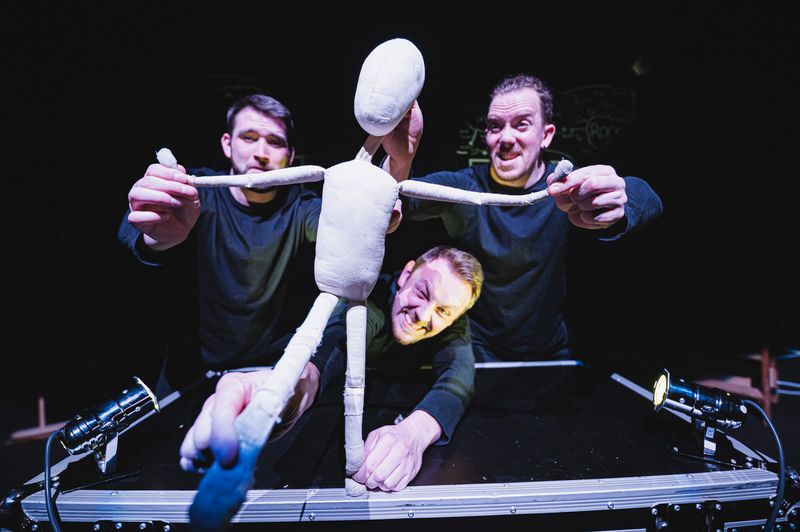
Meet Fred returns to the UK on its 10th anniversary tour, offering audiences another look at Hijinx Theatre and Blind Summit’s thoughtful examination of care, autonomy and the systems that govern both.
Fred, a faceless, two‑foot‑tall puppet crafted from plain white cloth, longs for an ordinary life: work, companionship, a sense of belonging. Operated via traditional Bunraku‑style puppetry, he is animated by three visible performers – one guiding his head and voice, one shaping the arms, the third controlling the legs. Their constant presence ensures Fred’s autonomy is never taken for granted; his agency is always shared, always conditional, always at risk.
Despite his simplicity, he is remarkably expressive, capable of humour, frustration and fleeting existential awareness. The technique doesn’t just animate him – it becomes a central metaphor for dependence and care.
Revisiting Meet Fred now gives its themes a sharper edge, particularly in an England where disability support is under such close and constant scrutiny.
Meet Fred review – quick links
Puppetry with astonishing emotional range
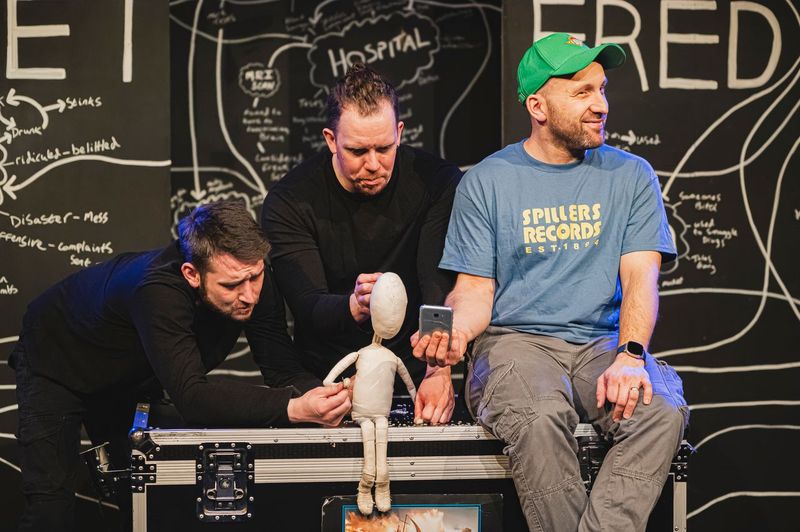
Fred’s world begins to collapse when his Puppetry Living Allowance (PLA) is threatened. When his support is withdrawn, the puppeteers must decide which one of them gives up their role and, by extension, which part of Fred’s body he will lose. When the puppeteer responsible for his legs is forced out, Fred’s lower half collapses instantly, his mobility reduced to whatever the remaining support can sustain. The Bunraku form makes this brutally visible, turning a bureaucratic loss into a physical unravelling.
The puppetry is Meet Fred’s most exceptional achievement. The Bunraku team work with such precision and intuitive coordination that Fred feels less manipulated than inhabited. A minute shift of weight, a brief hesitation before a gesture, the sense of breath passing through cloth – all build a character with astonishing emotional range.
Nicholas Halliwell, who controls Fred’s voice, head and left arm, leads with an exceptional vocal performance, but it is the ensemble’s collective listening and shared focus that give Fred his soul. The artistry is rigorous, delicate and often quietly breathtaking, transforming a bundle of fabric into someone audiences instinctively care for.
The real costs of bureaucratic decisions
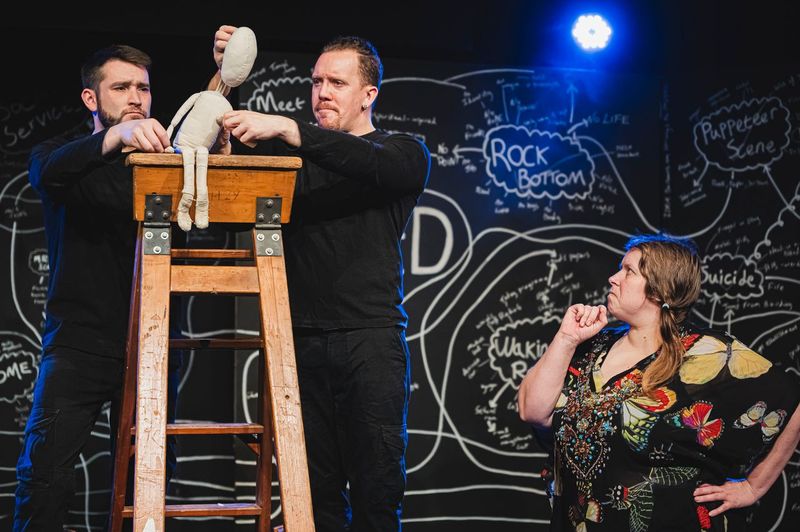
For all its political backbone, Meet Fred often handles satire with a welcome lightness. The Department of Work and Puppets – a thinly veiled analogue to real‑world assessment systems – provides the show’s sharpest humour, exposing how structures built to offer stability can just as easily unravel it.
Hijinx’s inclusive ethos is embedded throughout. Performers with and without learning disabilities and/or autism share the stage, and the production is captioned throughout, woven cleanly into its rhythm. The set charts the possible routes Fred’s life might take – from marriage to hospital to prison – giving his journey a sense of predetermination. Each choice leads visibly to its next consequence, a wry reminder of how little space there is for deviation when external structures map out the path ahead.
For all its strengths, the production doesn’t always manage the balance it strives for. Several scenes overstay their ideas, softening the impact of the sharper turns. Tonal transitions falter in places, and the climactic scene in which Fred meets his maker – a moment that gestures toward deeper existential ground – ultimately fizzles, landing without the emotional clarity the piece has been building toward.
Gareth John’s recurring appearances as stagehand Martin add charm and unpredictability, though these moments don’t always sit comfortably within the wider arc, contributing slightly to the uneven rhythm.
Where Meet Fred resonates most is in its quieter, more focused passages: the slow removal of support, the pauses charged with frustration, the moments that illuminate how systems fail those they are meant to serve. These sequences hold particular weight in the present English landscape, where disabled communities continue to navigate inconsistent support and bureaucratic constraint.
Ultimately, Meet Fred stands out for its craft and clarity of intent, a production most affecting when it lays bare the cost of a system failing the person who depends on it.