The Henry Moore Institute (HMI) in the cultural heart of Leeds offers visitors a wonderful opportunity to experience and enjoy the very best in sculpture from around the world – just don’t expect to see any Henry Moore works whilst you’re there!
Proudly standing next to the impressive Leeds Art Gallery, and just a few steps from the Leeds City Museum, the HMI houses four sculpture galleries, a comprehensive research library, and a fascinating archive of sculptors’ papers. This is a place designed for study and contemplation as well as for enjoying the numerous exhibitions and displays. The library and archives are really very special. With more than 30,000 books, journals, and ephemera, this is one of the largest sculpture libraries in the world and is open to all.
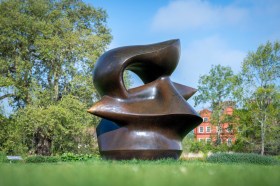
Henry Moore (1898–1986) was born just down the road in Castleford and began his training in Leeds; he went on to become one of the most important sculptors of the 20th century. Moore believed strongly in the role of public art in making sculpture accessible to a wider audience. His large-scale works are often found in prominent locations such as The Arch, standing by the Serpentine in London’s Kensington Gardens, and Three Standing Figures in Battersea Park.
And whilst his works may not be shown here at the HMI you can see a number of his major pieces in the massive 500-acre Yorkshire Sculpture Park and at the Henry Moore Studios and Gardens in Hertfordshire. There’s also a major show with 30 monumental works planned for Kew Gardens next summer.
Read: Metamorfoza at the 2025 Belfast Photo Festival
The HMI was formed in 1993, building on the long-standing partnership between Leeds City Council and the Henry Moore Foundation that began with the development of the Sculpture Study Centre in Leeds Art Gallery in 1982.
The Foundation had been established by Moore and his family in 1977 to encourage public appreciation of the visual arts and to give back to the city. It continues that work today, supporting innovative sculpture projects, creating an imaginative program of exhibitions and research worldwide, and preserving the artist’s legacy.
The HMI hosts a busy calendar of historical, modern and contemporary exhibitions and events that encourage reflection about the nature of sculpture, how it is made and the artists who make it. It is a hub for sculpture, connecting a global network of artists and scholars and promoting research into the art form.
Fragment and Form
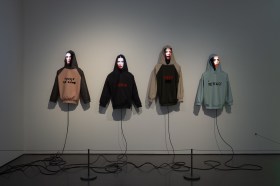
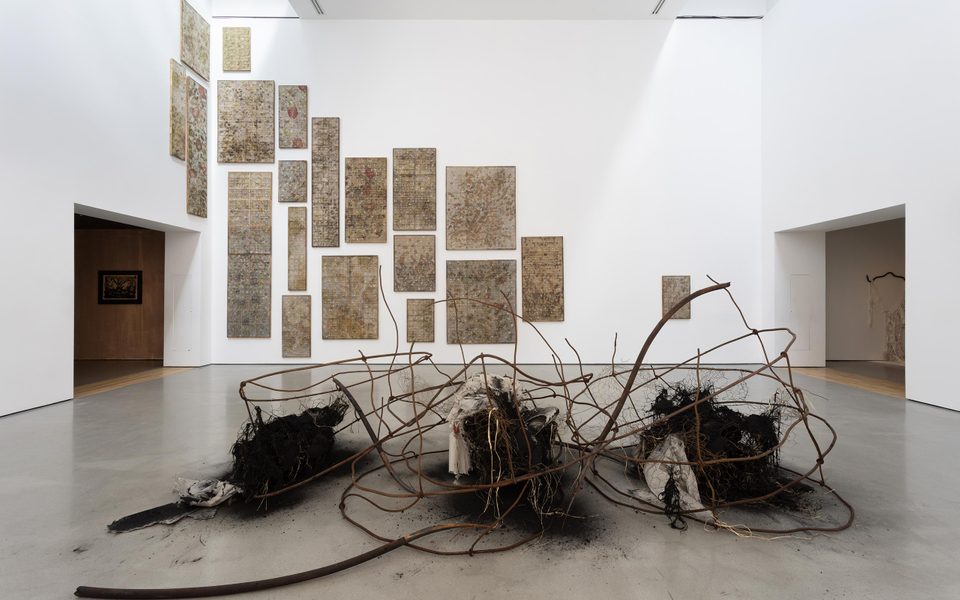
The current exhibition, Fragment and Form, features works by contemporary artists Emii Alrai, Dominique White, and Mónica Mays. Curated by the head of HMI, Laurence Sillars, the exhibition continues the dialogue between history and materiality in sculpture. While distinct in style and form, the works converge in their physical and narrative exploration of heritage, displacement, and the ways in which personal and collective histories are preserved, marginalised and contested through materiality.
The works attest to the formation and fragmentation of history in a thematic notion that resonates throughout the exhibition. There are metaphors here about the complexities of representing the passage of time, the presentation of truth and the creation of myths.
The relationship between history, myth and materiality has been a central concern throughout the evolution of sculpture. From classical marble statuary to the use of industrial materials, plastics and found matter in more recent practice, sculptors often choose materials that say something. This goes beyond their physical properties to deepen meaning and embody the cultural, political and spiritual narratives of the age.
Fragment and Form opens with a sculptural intervention by British-Iraqi artist Emii Alrai that transforms the usual architecture of the gallery space and reorients your perspective. These bold installations hold their place as ‘speculative reconstructions’ of displaced or looted artefacts. At the heart of this work is a thoughtful critique of museum practices and the hierarchies of preservation that shape dominant historical narratives.
Further on is Shadow Boxes, an expansive new installation of Mónica Mays’ delicate and hauntingly beautiful wall-mounted assemblages that resemble taxonomy drawers filled with cocoons, flower-dyed silks and brass fittings.
These talk to the history of scientific traditions and more intimate rituals. Mays is a Spanish artist whose work examines cultural identity and memory through the lens of domestic objects and everyday rituals.
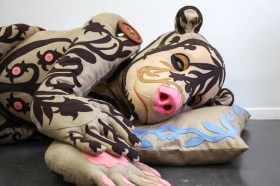
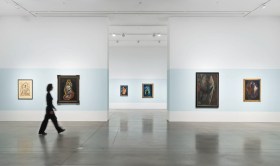
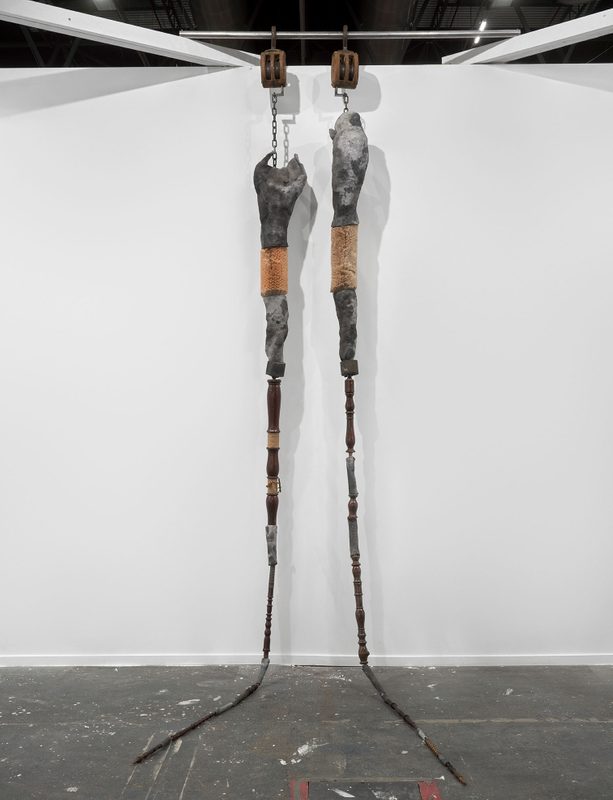
There’s a powerful theme here about the fragility of inherited memory and the works are beautifully hung in the all white gallery space. Mays’ rather startling pieces Long Limbs Pump Abductors Ashes to Ashes (2024) and Without Ornamental Value (2024),quite different from Shadow Boxes, are works that will stay with you long after you leave the gallery.
Dominique White’s work The Domination of Nothing (2023) takes over the central gallery space. This is a skeletal sculpture assembled from charred mahogany, volatile charcoal, destroyed sails and rusted iron that looks like an imagined shipwreck and reflects themes of absence, refusal and collapse. This is accompanied by White’s other pieces, A flag of victory, a trophy of defeat (2019)and A beast of burden (2024). These works extend White’s ongoing explorations of resilience, liberation, Black identity and Afrofuturism.
Viewed together, the works in Fragment and Form talk to the role of sculpture as a tool in the interrogation of the legacies of power and historical erasure.
They ask viewers to reflect on how material culture can both preserve and challenge historical narratives, and how the legacy of colonialism continues to shape the objects we value and the stories we tell about the past.
The three artists see history ‘not as a fixed narrative, but as something unstable, fugitive, and open to transformation’. Importantly, each artist talks to these themes in their own unique style forming ‘a chorus of echoes and departures, an exhibition built from shards, ghosts and gestures that resist closure’.
There’s also a smaller exhibition on display in the Study Gallery at the HMI. Passing Strange: British Land Art through Time seeks to reappraise the land art movement, a practice of sculptural and conceptual experimentation from the 1970s to the present day, and consider how it has shaped our understanding of landscape.
With works by Tacita Dean, Hamish Fulton, Anya Gallaccio, Andy Goldsworthy, John Hillard and David Nash, this exhibition highlights how these artists have defamiliarised landscape and natural forms.
They articulate an alternative vision of land art and show how artists can embrace transience and rebirth rather than permanence and monumentality.
Following these exhibitions, a group show Beyond the Visual will open at the HMI in late November. This will be the first major sculpture exhibition in the UK where blind and partially blind practitioners are central to the curatorial process and are the majority of exhibitors. Featuring 16 national and international artists, Beyond the Visual is dedicated to ‘challenging the dominance of sight in the making and appreciation of art’ and seeks to transform how museums and galleries engage with blind and sight-impaired visitors.
The Henry Moore Institute is a key part of the beating cultural heart of Leeds on The Headrow. Attached by an internal footbridge to the adjoining Leeds Art Gallery, with its two floors of galleries and stunning Victorian Tiled Hall Café, it is a perfect place to while away an afternoon or two. And wonderfully, it is always free to enter.
Fragment and Form is showing at the Henry Moore Institute, The Headrow, Leeds until 2 November 2025.