Jonathan Baldock’s Held is an exhibition about touch: its comforts, its dangers, and its ability to collapse the boundaries between intimacy and control. Through ceramics, felt, sound, scent and participation, Baldock constructs a world steeped in pagan folklore yet shaped by distinctly contemporary experiences of isolation.
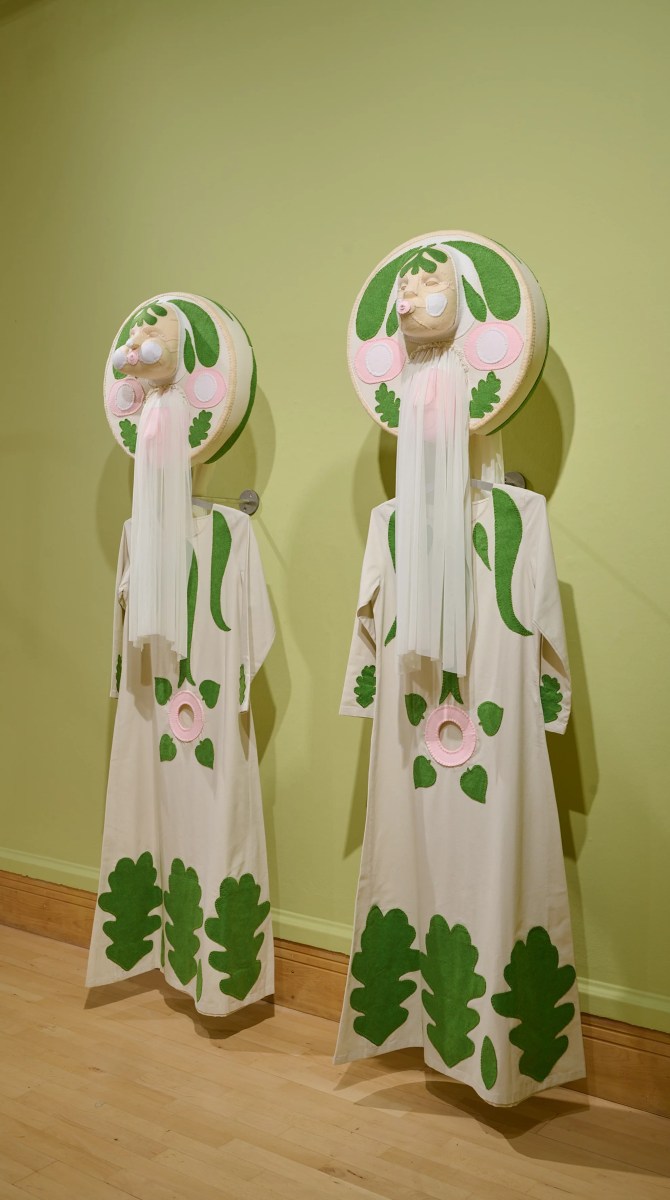
The exhibition opens with The Caretakers, a pair of life-size felt figures standing as ceremonial thresholds. Clad in garments embroidered with hand-stitched greenery, their quiet, sentinel-like presence invites visitors into a world where care and unease are never separated. From there, the gallery gradually reveals itself through scent, vibration and touch, transforming the gallery into a place somewhere between shrine and forest.
Jonathan Baldock review – quick links
Bringing the outside in
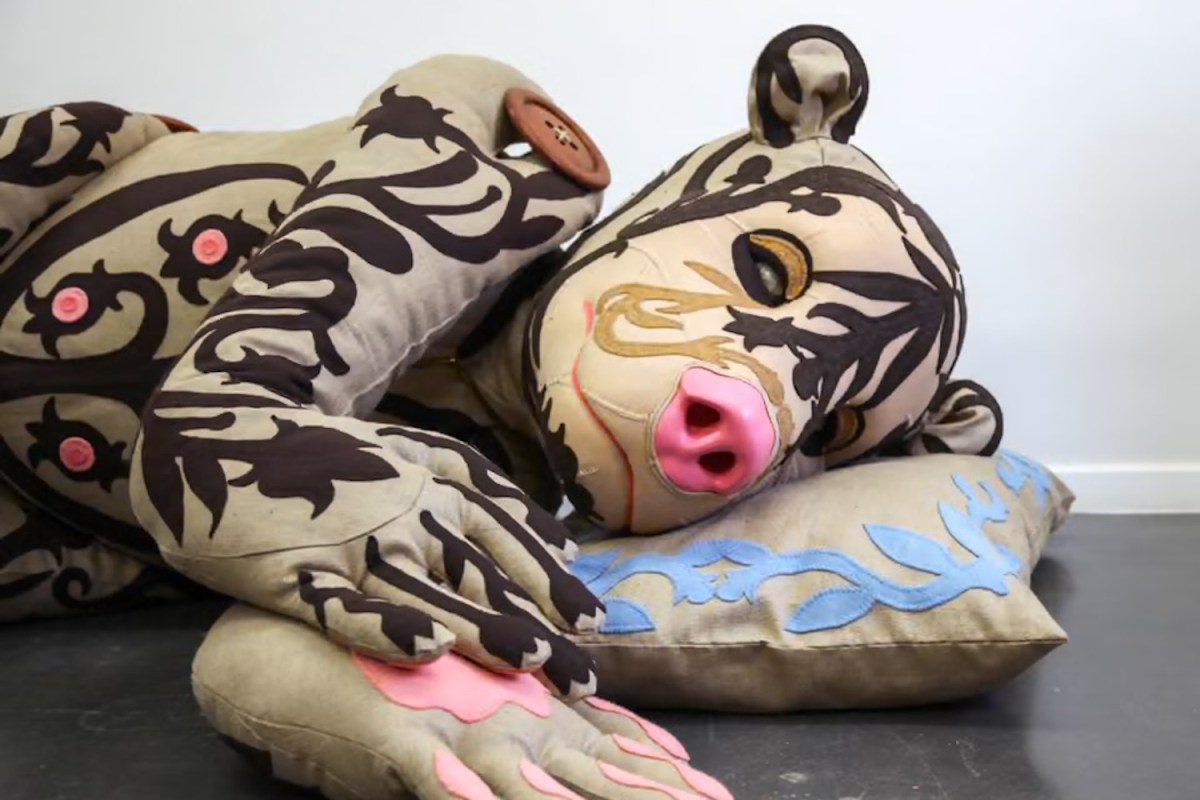
Baldock has collaborated with Lora Hemy, whose custom olfactory work fills the air with the pungent musk of damp wood, moss, and animal fur, while Luke Barton’s low-frequency soundtrack sends vibrations through the floor. Snapping twigs and heavy breathing appear to emanate from Baldock’s Bear Hug, a monumental bear resting on a raised platform.
Inspired by Michel Pastoureau’s The Bear: History of a Fallen King, the sculpture traces the animal’s transformation from sacred forest deity to domesticated childhood companion. Visitors are invited to remove their shoes, climb onto the platform and wrap themselves within the bear’s vast felt limbs.
This element of participation is a gesture that destabilises the reassuring familiarity of tactile experience. The embrace oscillates between comfort and threat: is it a teddy bear or a grizzly bear? That ambiguity becomes even more psychologically charged once the bear’s face is understood as a digital cast of the artist’s mother, weaving maternal protection and claustrophobia into a single public monument.
There is another, quieter transformation taking place. Adults willingly perform gestures associated with childhood – removing their shoes, climbing onto a platform as though crawling into bed, embracing an oversized teddy bear – only to discover that these familiar acts no longer offer uncomplicated security. Baldock turns regression into something deeply unsettling, suggesting that vulnerability is not something we outgrow but something we continually renegotiate.
Twisting the folkloric and familiar
This tension extends throughout the remainder of the exhibition. If these works risk leaning heavily on the familiar iconography of myth, Baldock’s wit and material inventiveness prevent them from ever becoming merely illustrative.
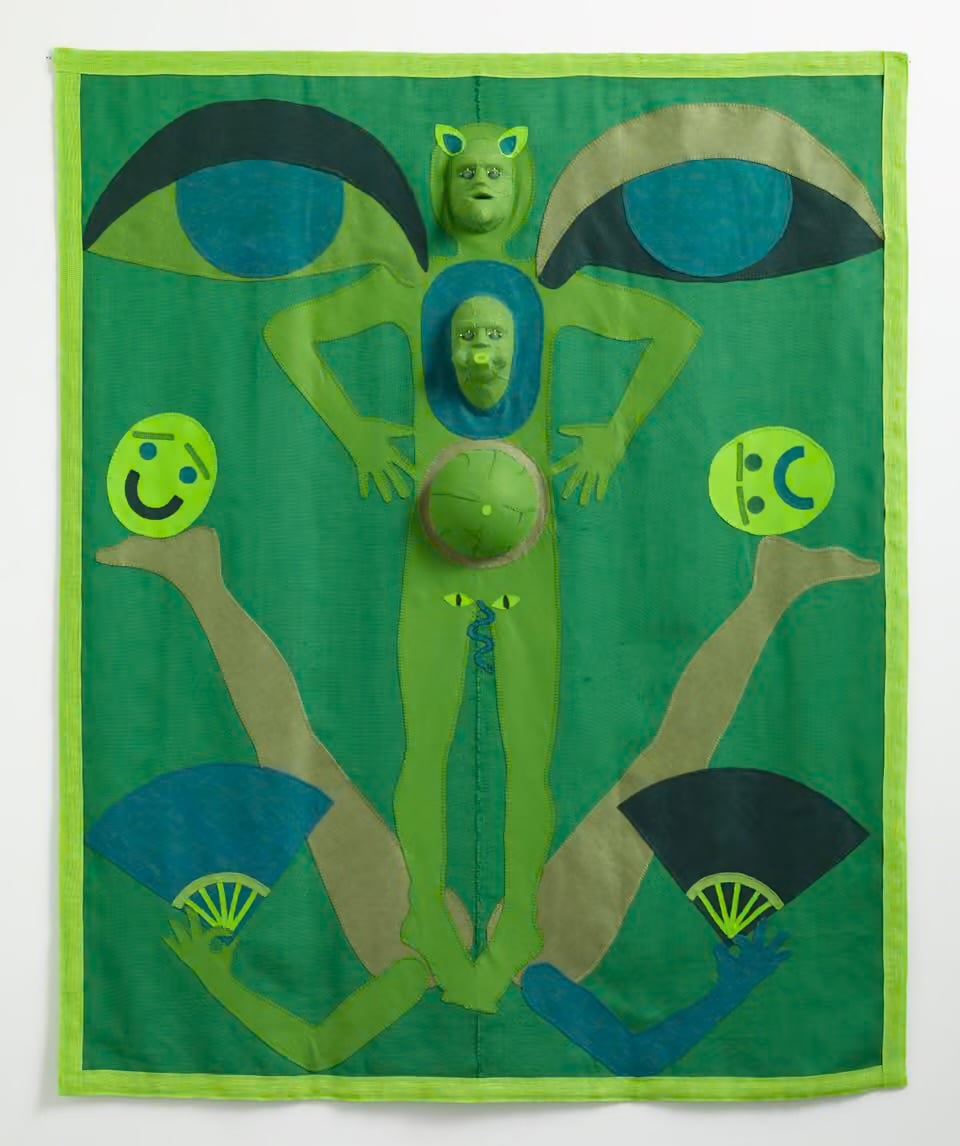
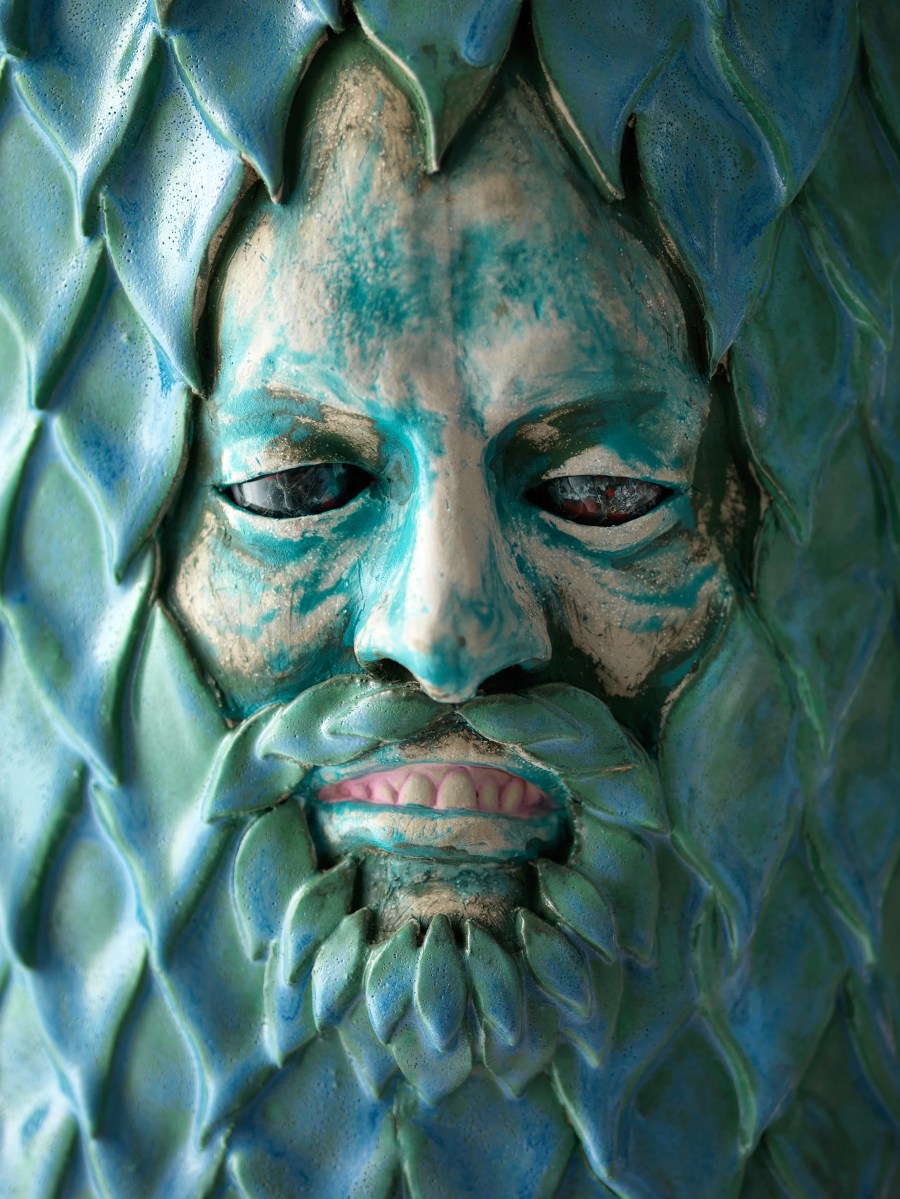
On the walls, sprawling tapestries such as Nature to be commanded must be obeyed weave together geometric patterns, Celtic knots and figures of the Green Man. Constructed from felt, hessian and silk, they resemble fragments of folklore reassembled for the present rather than relics from a distant past.
Beneath them, ceramics quietly undermine their own domestic familiarity. In A Foliate Offering and They were common and close, I had no room for growth, stoneware vessels sprout clay hands, limbs and anatomy, transforming everyday objects into strangely animate bodies – including a rogue tongue poking directly from the centre of an artichoke-like face, threatening to lick you as you pass.
Rather than treating touch as inherently healing, Held insists on its instability. Every invitation to comfort also carries the possibility of exposure; every act of closeness risks becoming a loss of boundaries. Baldock leaves those possibilities wrapped tightly around one another, making the exhibition’s final embrace impossible to classify as either consolation or warning.