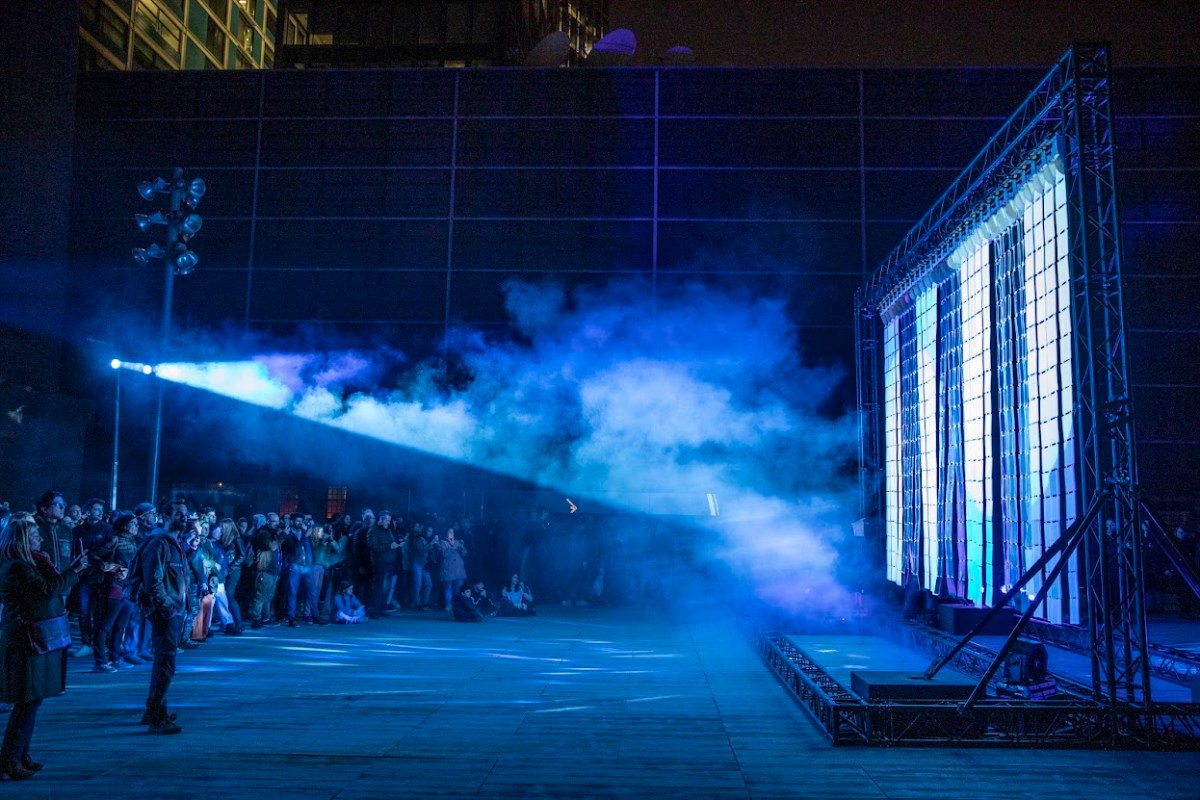
Bristol knows how to put on a show. But the 2026 Bristol Light Festival understands that illumination works best when it reveals rather than decorates. From the damp limestone of Redcliffe Caves to the steel arcs of the Clifton Suspension Bridge, the trail treats the city itself as circuitry – infrastructure not as backdrop, but as medium.
Bristol Light Festival review – quick links
From mechanical movement to the turning of the seasons
Underground, the most arresting piece is Parker Heyl’s Jacob’s Wall in the Redcliffe Caves. Hundreds of wooden tiles flip and clatter in rhythmic bursts. Heyl calls it ‘material computation’: binary logic made mechanical. There are no pixels here, no smooth LED wash, just the percussive knock of wood on wood reverberating through limestone. The effect is oddly stirring – less screen, more machine.
Above ground, attention turns to the Clifton Suspension Bridge. A Year in the Life of the Avon Gorge and Downs is the first LED illumination the bridge has ever seen. Its steel arcs shift through the seasons in a ten-minute sequence, from spring violets to high summer warmth and a winter fade to white.
The effect comes as a hidden surprise – this work was not advertised in the festival’s lead-up – making the moment feel all the more magical. There is a definite sense such a canvas could sustain something grander, yet the quiet restraint proves wise and the projections never overpower the structure. The bridge remains the star.
Interactive works draw the audience in
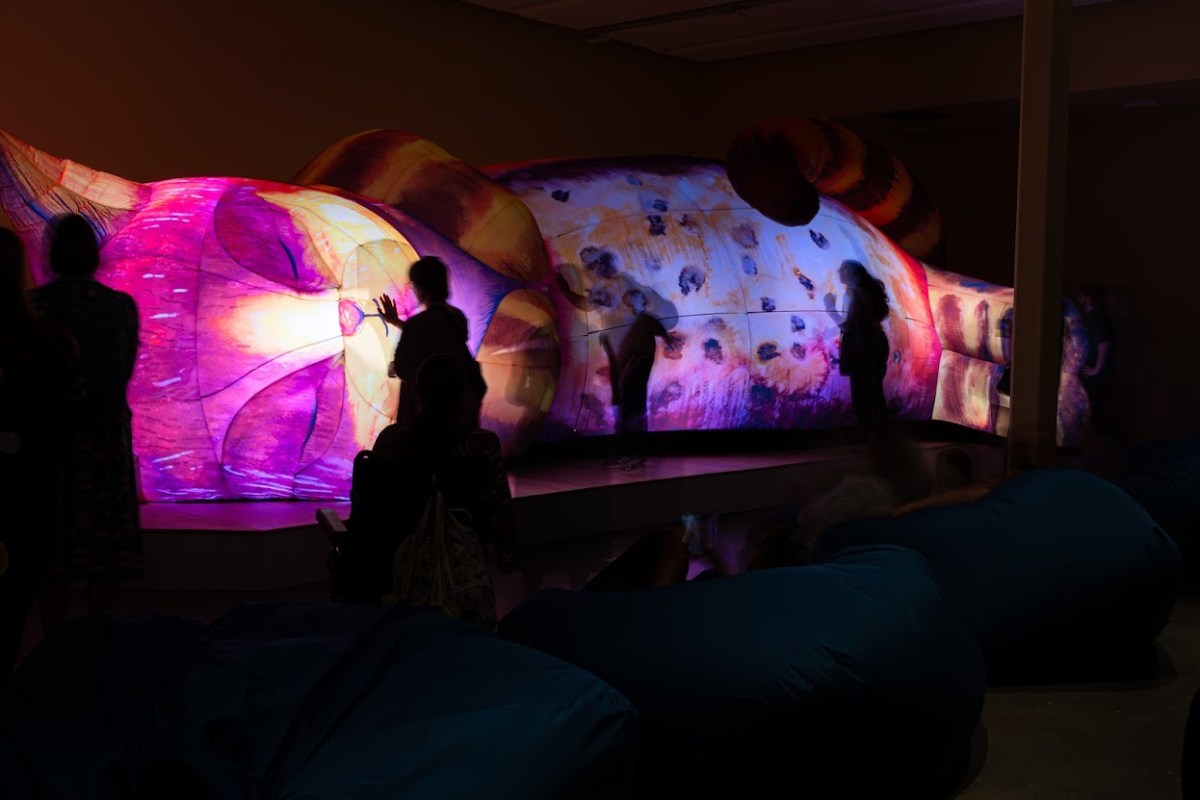
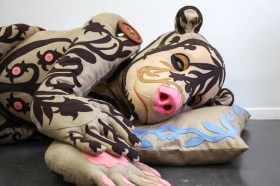
The trail moves from the industrial to the biological at Cascade Steps, where Air Giants’ The Cat That Slept For A Thousand Years – a 10-metre soft-robotic feline – curls serenely beside the water. Nearby on College Green, Cameron Balloons’ The Lite Series invites visitors to pull cords that trigger bursts of heat and light, echoing the familiar roar of Bristol’s ballooning heritage.
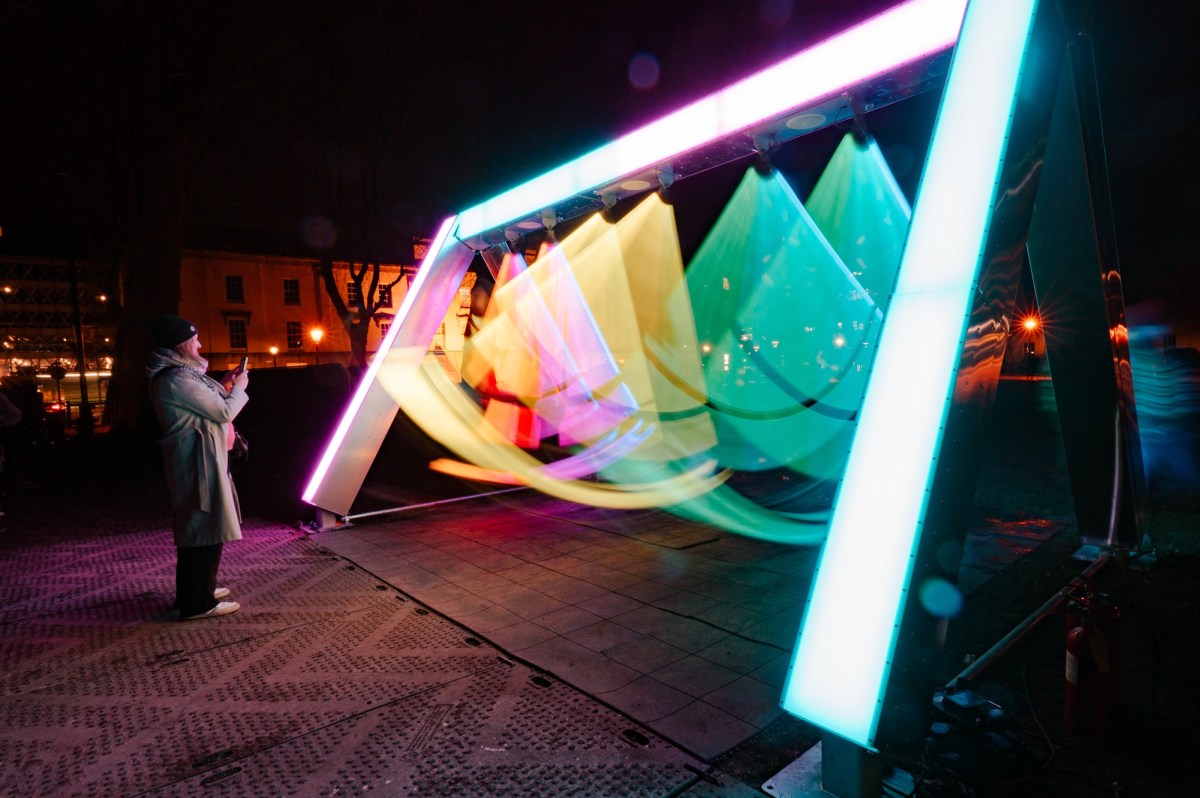
Participation is another strong thread. In Portland Square, Swing Song turns play into live composition. Each swing activates a different musical layer, so the soundscape shifts depending on who climbs aboard and how they move. The result is fluid rather than fixed – sometimes harmonious, sometimes gloriously chaotic.
Nearby at Finzels Reach, Rob Hodgson’s Jellymonsters are simple and bright. Their animated forms are triggered by a public microphone that quickly becomes irresistible. Younger visitors are often the most enthusiastic – singing, shouting and testing the acoustics – though adults are hardly immune.
The appeal is immediate, even gleeful. Yet beneath the playfulness sits a neat idea: cities are shaped, quite literally here, by the voices that fill them.
Responding to history and place
The Bristol Light Festival also turns to history at the Clockwise Generator Building, where Illuminos’ The Electrical Age uses projection mapping to trace 150 years of energy, from early tramway grids to the pioneering work of the Electrical Association for Women.
The most immersive moment comes high above Cabot Circus, where Liz West’s Our Colour & Our Colour Reflection transforms Level 7 of the car park into a suspended field of mirrored discs and saturated light. What is usually a site of circulation and consumption becomes unexpectedly contemplative.
At the RWA, Studio McGuire’s Bell Jar Fairies presents digital miniatures beneath glass domes, offering a quiet counterpoint to the festival’s larger interventions.
The trail concludes in Royal Fort Gardens, where Will Budgett’s The Midnight Ballet arranges abstract, matted clusters of recycled steel into sculptural forms that seem inert by day but, under illumination, cast impossibly human shadows – fluid, graceful and lithe. The transformation borders on witchcraft.
Bristol Light Festival works because it resists treating light as mere ornament. When technology is applied with an understanding of history, ecology and participation, the city does not simply glow in the dark, it feels momentarily rewired.