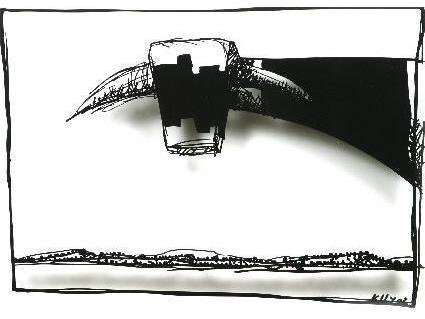
John Kelly, Head in a landscape, Image via Anthea Polson Art
‘Accepting another person’s gift is allowing him to express his feelings for you.’ Alexander McCall Smith
“Rich gifts wax poor when givers prove unkind.” Shakespeare (Hamlet)
Recently Australian artist John Kelly had a dilemma. He posted the following slightly uncomfortable message on his Facebook wall.
‘How should I feel when gifts given to friends are sold at auction? A work is coming up ) at Menzies… the ‘friend’ does not contact me to explain the reasons for the sale…I actually find it extremely distressing. Am I being too sensitive?’
Kelly’s camouflaged cows and his public sculptures such as Cow up a Tree in Melbourne’s Docklands and Champs del la Sculpture II on the Champs-Élysées are well known and his now fetches tens of thousands of dollars in the secondary market.
So the money-minded can see how someone with a Kelly in the house might be tempted to on-sell. But Kelly finds it hurtful when works he has gifted to friends find their way to auction without so much as an advisory phone call to the artist.
‘It’s distressing because when an artist gives a work of art it is an act of love, kindness and friendship towards somebody they cherish. When that friend sells that work – without informing the artist – it is a direct repudiation of all those wonderful things – it also destroys all the intangible qualities of the artwork that makes it a ‘gift’.
‘An art object is not an inert ‘object’ like a gift voucher where the giver’s name can be easily erased. For people to suggest that the artist should just let it go, move on or get over it may be well intentioned, but does not take into account that an artist can never let their work go. It’s an integral part of who they are.’
The money or the art?
The dilemma of art-as-gift is a subset of the constant tension between art’s fungible value as an investment and its less tangible qualities as an emotional vehicle.Once the work has passed to the recipient, it is legally his or hers to keep or sell as they wish. But on an ethical and human level, does the does the generosity of gift-giving demand a more restrained response from someone who finds themselves with a potential bonanza in the house?
The problem arises not only for individuals but also for institutions. In 2010 the Art Gallery of NSW sold off a major gift from author Patrick White, an Ian Fairweather work Gesethame which was bought by prominent dealer Phillip Bacon. The sale raised some $900,000, which paid for a new acquisition for the institution, but not without raising a few eyebrows at the time. There was a lot of criticism about the appropriateness of selling off a gift to raise money, especially one from a donor as prominent as White.
Director Edmund Capon was unrepentant. ‘Collections have to be edited sometimes. The (previous) ownership of Patrick White is irrelevant. We’re not a social history museum. We’re a museum of art.’
A further complication is that gifts are sometimes forgotten or disputed. Recently John Olsen sued Sotheby’s Australia over what he thought was a stolen piece from the 1960s. It emerged during the court case that Olsen had in fact gifted the work to friends back in the 1960s and he had forgotten about it.
On the other hand a personal connection may improve provenance or even boost value, according to Paul Sumner of Mossgreen. ‘If the recipient has a personal connection to the artist, then this can add value, but unless the reason for the gift had great historical significance, its increase in value is only marginal. But that said, this kind of provenance can dispel any concerns over authenticity,’ said
How artists feel
Not all artists are as sensitive as Kelly. Portia Geach and Wynne prize winner Natasha Bieniek said she would not be bothered by someone selling a work she had gifted.
Charles Blackman feels the same way. His son Auguste Blackman observes, ‘Dad grew up when everyone around him was poor. He gave away a lot of work and never had a problem with someone selling it….He loved it when someone got ahead in life.’
Others feel there are grey areas around the ethics of on-selling . Mid-career artist Sam Leach half-jokingly suggests a statute of limitations might make the selling of an artist’s gift less hurtful.
He also maintains an active engagement with work he has given away. ‘I’ve asked for some gifts of early works back from friends. When I would go to their house for dinner I’d be looking at these paintings that I didn’t think were representative of me, so I replaced them.
‘I’ve also had to go to greater lengths to destroy my work now to ensure what ends up in the skip doesn’t accidentally end up in the marketplace.’
Leach points out there is practical value to knowing where his work is going, in case he wants to exhibit it for a retrospective.
Kelly is more comfortable – though reluctantly so – when a friend contacts him in advance of a sale and explains why they are disposing of the work.
‘It is still disagreeable however I have agreed and continue to have friendships with these people and admire their ability to communicate in difficult times. It shows respect for the artist and the art. And a gift can be sold in a very positive way. Recently a friend’s daughter helped pay for her wedding day with a small painting I had gifted the family. Beforehand she sent me a lovely note asking permission to sell the painting to help fund this special occasion. Of course I was happy to agree.’
Auguste Blackman disagrees that the circumstances of a gift or a sale matter. ‘There are no levels to giving. You just can’t half give something.’
The lesson, according to Sumner, is not so much for gift recipients as for artists. ‘Ultimately we are all caretakers for everything and one day all artworks will be sold, but artist’s need to think carefully about who they gift their artworks to in their lifetime.’