There’s no consensus on what an emerging creative practice is. The Vogel Literary Award, established in 1980, is famously for authors under 35. The Museum of Contemporary Art’s annual Primavera art exhibition, founded in 1992, also stipulates 35. That link between emerging practice and youth is strong, although it is slowly changing.
‘It’s a tricky one,’ said Ruby-Rose Pivet-Marsh, the artistic director of the Emerging Writers’ Festival. People often assume the festival is just for young writers, she said, but that’s not the case. ‘We do try to program older emerging writers as well. We’re quite conscious of that.’
Across the arts, there is growing awareness of the different factors that can affect when and how people take up creative practice. It’s been building for some time. In 2009, the National Gallery of Australia held an exhibition called Emerging Elders, honouring early career First Nations artists like Nyapanyapa Yunupiŋu. The Yolgnu artist came to art late in life and has gone on to exhibit in the Biennale of Sydney and internationally.
Age-old problems
Successes like Nyapanyapa’s have helped to shift some of the focus away from age. Overland’s Victoria University Short Story Prize for New Writers and Griffith Review’s Emerging Voices Competition are for writers who have published no more than one book. Other opportunities, like the Telstra Emerging Artist Award in the NATSIAAs, define emerging as the first five years of practice.
Pivet-Marsh is wary. Definitions like the first five years are ‘quite limiting and puts a lot of pressure on people,’ she said. Similarly, it’s difficult to apply hard and fast rules, like number of published works, because ‘there are so many different disciplines within writing’.
The festival now leaves it up to writers to decide. There is an open-call every year and writers can nominate whether they see themselves as emerging.
‘People who are emerging in our program are usually performing at an event for the first time, or perhaps haven’t been published yet but are really dedicated to their craft,’ she said.
So is it a useful label for artists?
For artists, the lack of clarity around the emerging label can make it hard to see how it applies to their own practice. Sydney-based musician and composer Keyna Wilkins said she had never found it that relevant, beyond grant applications.
‘It’s nearly impossible to earn a liveable amount of money from composition and a lot of composers have other sources of income – I do a lot of teaching – so even if a composer gets very successful, they can still feel like they’re emerging,’ she said.
When the topic comes up in conversation with other composers, Wilkins said there was a general feeling that they could be very busy but still be considered emerging if they were ‘not super well known’.
Read: Top 3 tips for emerging arts managers
By the same token, those who were well known could also be considered emerging if they only had a few projects a year. ‘I think it’s a bit of a vague term,’ she said.
Brisbane-based artist Monica Rohan, whose solo exhibition Mind how you go opens at Brisbane’s Jan Murphy Gallery on 16 March, has also found it hard to pin down. ‘It seems to apply in a blanket way to so many unique careers,’ she said. ‘When I was in that phase, artists who I looked up to, and considered established, were also referred to as emerging.’
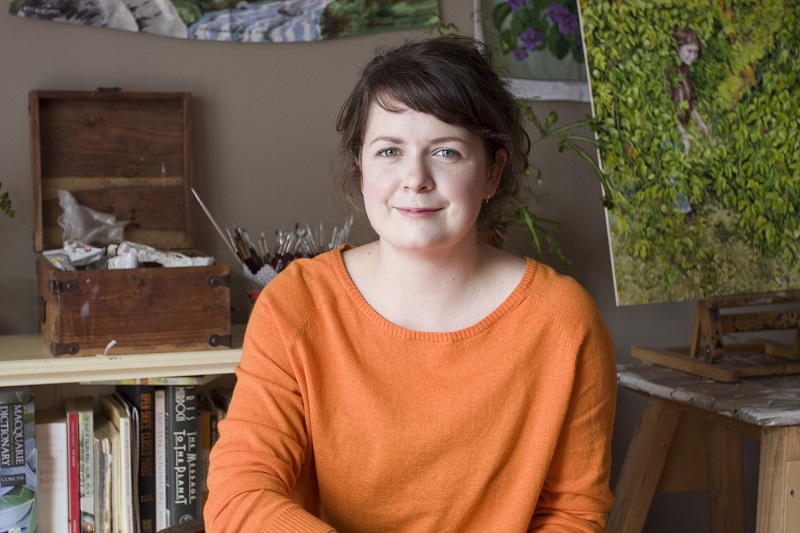 Artist Monica Rohan says the emerging label ‘seems to apply in a blanket way to so many unique careers’. Photo credit: Llewellyn Milhouse.
Supporting younger artists
At the same time, the need to support young practitioners is fairly obvious to anyone thinking about the future of the arts. The Freedman scholarships, run by the National Association for the Visual Arts are for ‘young early career’ artists rather than emerging artists. The Brett Whiteley Travelling Art Scholarships are for artists from 20 to 30. And the new Ultimo Prize, launched by Ultimo Press, seeks work from 18 to 30 year old writers.
‘We thought it was time to launch a prize that gives a platform to multiple new writers at once,’ said Ultimo Press publisher director Robert Watkins. ‘We intend for the entry requirements (and the subject matter that serves as inspiration for the winning pieces) to change year on year. We recognise that authors can emerge at any age, but this year is the very beginning of the Ultimo Press journey – so it felt appropriate.’
This year, the Text Prize has also added a new mentorship prize for young writers under 25. It’s named in honour of the late Steph Bowe, who published her first book at 16 and who passed away at 25. The new prize speaks to the need to support work for young people written by young people.
Getting the balance right
‘In order to have a flourishing publishing industry we need writers to be supported, promoted and encouraged at all ages,’ Watkins said, adding he hoped the new prize would grow with Ultimo Press.
Not everyone is convinced we have the balance quite right. ‘Of course young people need opportunities, but it seems quite disproportionate,’ said Wilkins about what she sees in the contemporary music sector. ‘It takes time to mature your voice and vision. And I think for women, when many women take time off to have children, this can be further delayed.’
One reason that definitions around age and years of practice have stuck around so long might be simplicity and convenience. Another might be the youth-focus of mainstream culture and the way the emerging label has been bedded into some of the markets surrounding the arts. One of the major art fairs in the Asia Pacific region, Art Basel Hong Kong, has a section called Discoveries for emerging artists, for example. In some contexts, emerging is now shorthand for potentially the next big thing.
Real transitions
Despite their doubts about the label, both Rohan and Wilkins do recognise a transition in their work.
In Rohan’s practice, there was ‘definitely a shift in confidence,’ she said. The backing of galleries helped here. Rohan was picked up by Jan Murphy Gallery shortly after she graduated from art school, followed closely by Sophie Gannon Gallery in Melbourne. For her, confidence meant being able to ‘develop my work and take it in new directions while still maintaining interest,’ she said.
Read: Emerging artists: too much too early
‘More financial stability has also made a big difference,’ Rohan said. ‘When I had my first solo show with Jan, I was still working part-time in a cafe and making paintings in the sunroom of my share-house.’
Pivet-Marsh also suggests this transition is about confidence. ‘That point where maybe you’re ready to mentor people or to share your knowledge … is probably where I would say you’re becoming a little bit more mid-career,’ she suggested. ‘You have skills that you’ve been developing that you’re ready to share with other people.’
It doesn’t always run that way. ‘Sometimes I get applications from people who have had two books published and they still consider themselves emerging writers. And I’m just like, no, you’re pretty well established. You’re doing incredible things.’
Reaching out
‘For me, I became more prolific and confident when I returned to work after having children,’ said Wilkins. ‘I seemed to have a stronger vision for what sound I wanted. But the main thing was, I stopped worrying so much about what others think.’
She formed her own ensemble, Ephemera, who play her compositions and free improvisations, then another improvisation ensemble, Yulugi, and also developed a solo show. More recently, she has recorded and released three albums and is currently working on a concerto for The Metropolitan Orchestra in collaboration with Yulugi’s Gumaroy Newman.
‘I realised what I wanted out of music, and then just spent time finding the right people,’ Wilkins said.
Building communities
Rohan was selected for the well-regarded Churchie National Emerging Art Prize exhibition in 2012, just a year after she graduated from Griffith’s Queensland College of the Arts. While she didn’t think much of the emerging label at the time, ‘it did feel like a progression from four years’ describing myself as an art student,’ she said. ‘I think it was also a way of maintaining camaraderie with other recent graduates while entering the local ARI [Artist Run Initiative gallery] scene.’
‘I think that comes across all artforms,’ added Pivet-Marsh, about communities and how opportunities and knowledge are passed through networks. The Emerging Writers Festival is ‘a chance for writers ‘meet and interact with [their] peers. I think it’s really important,’ she said.
‘It’s something that we find a lot of artists comment on and one of the things that they really love about the festival. If you don’t go to uni, or you finish uni, you don’t have those peer-to-peer interactions in writing very much.’
Finding your own path
For Wilkins, her growing confidence has also been about ‘getting used to rejection and not being afraid of that any more,’ she said. ‘When I stopped being afraid, and just accepted that I’m going to keep doing this no matter what, things started to happen for me.’
Rohan’s experience was a little different. ‘I had a huge amount of support very early on in my career,’ she said, pointing to Jan Murphy Gallery and Sophie Gannon Gallery. ‘Seeing the paths that my peers have taken, particularly my husband who is also an artist … I know our trajectories are unique and there’s no generalised time-frame or set of milestones for an artist to attain.’
It’s a message often repeated in the arts. Tasmanian writer Ben Walter, whose short fiction has been recognised in a number of prizes, once wrote in Overland about the relief of passing the 35 cut-off for the Vogel. His point was about the all-eggs-in-one-basket mentality around pathways to success, and the Vogel, he suggested, was not always the career-maker that it’s made out to be. ‘Rather than being disappointing, this should be liberating,’ he said.
Emerging or not, all creatives face a similar task, to let go of expectations about their career, and find their own measures of success.