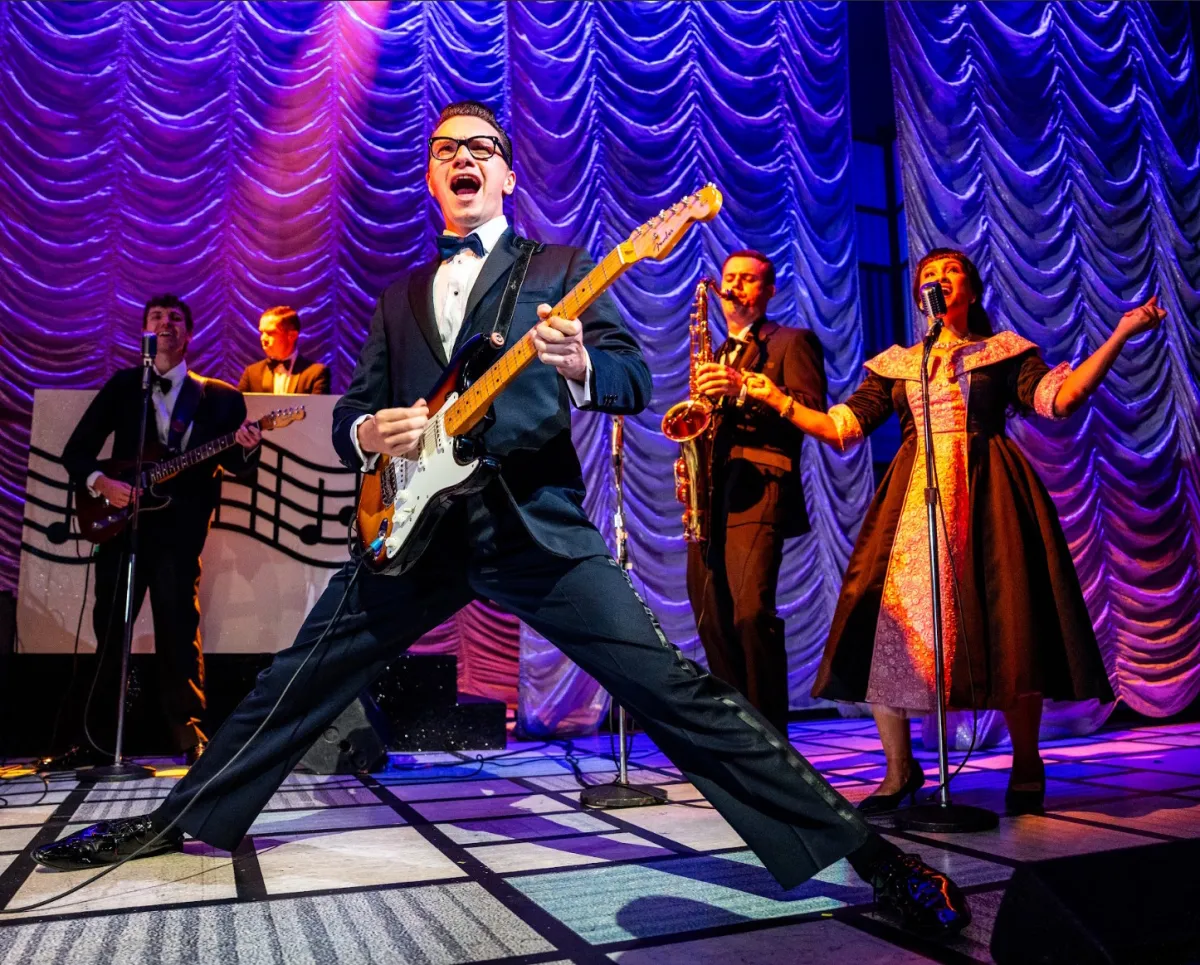
Decades after its West End debut, Buddy: The Buddy Holly Story returns as a lovingly maintained artefact: competently executed and musically irresistible, yet showing its age. As one of the earliest examples of the jukebox musical, it bears the imprint of a form that had not yet expanded into the scale or sophistication we now associate with the genre. Electrically enjoyable whenever the band locks in, the show itself feels tired rather than fresh.
Act one charts Holly’s ascent from Lubbock radio hopeful to rock’n’roll hitmaker with brisk efficiency. We move through early radio station gigs, the formation and fracture of The Crickets, and his whirlwind marriage to Maria Elena.
These scenes feel more like quickly checked boxes than fully realised drama – lightly sketched yet effective, without probing much emotional depth.
By act two, the show narrows its focus, recreating Buddy’s final performance at the Surf Ballroom in Clear Lake, Iowa, before the fatal flight. Here, the narrative largely gives way to the music, revelling in Holly’s catalogue – a choice both understandable and limiting.
The Buddy Holly Story review – quick links
AJ Jenks plays a poised Buddy Holly
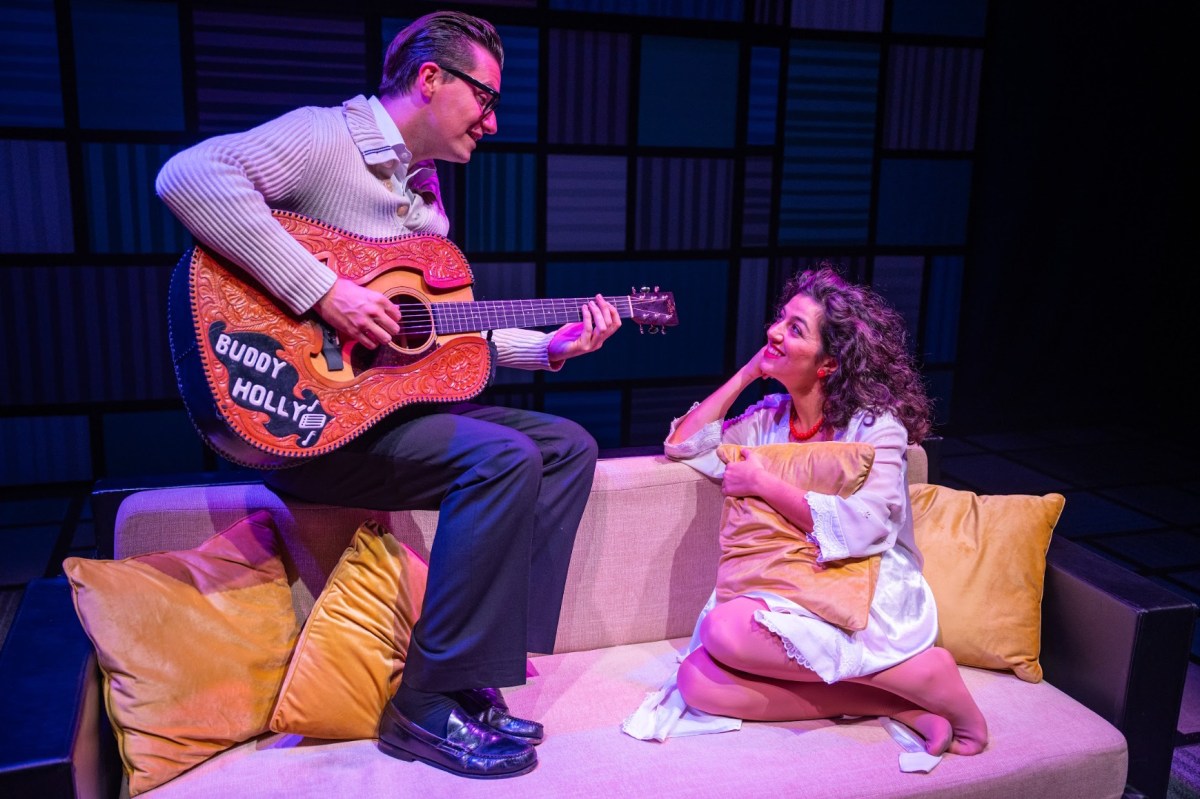
The cast cut through the narrative thinness with performances that hit exactly where they need to. AJ Jenks delivers a Buddy of wiry charm and quicksilver musicality, capturing the restless ambition of a young man moving at relentless speed.
His phrasing, poise at the mic, and trademark twang anchor the show’s emotional truth far more convincingly than the script could.
Miguel Angel’s Ritchie Valens injects La Bamba with kinetic energy. Joshua Barton’s Big Bopper embraces buoyant theatricality without tipping into caricature, while Melker Nilsson’s acrobatics on the double bass were a crowd‑pleaser.
Design‑wise, the production keeps things deliberately straightforward. Period‑faithful sets, lighting and costumes frame the action without attempting reinterpretation. The choices are tidy, professional and intentionally conservative – supportive rather than imaginative, and unlikely to leave a lasting visual impression.
The Buddy Holly Story: a wealth of choice
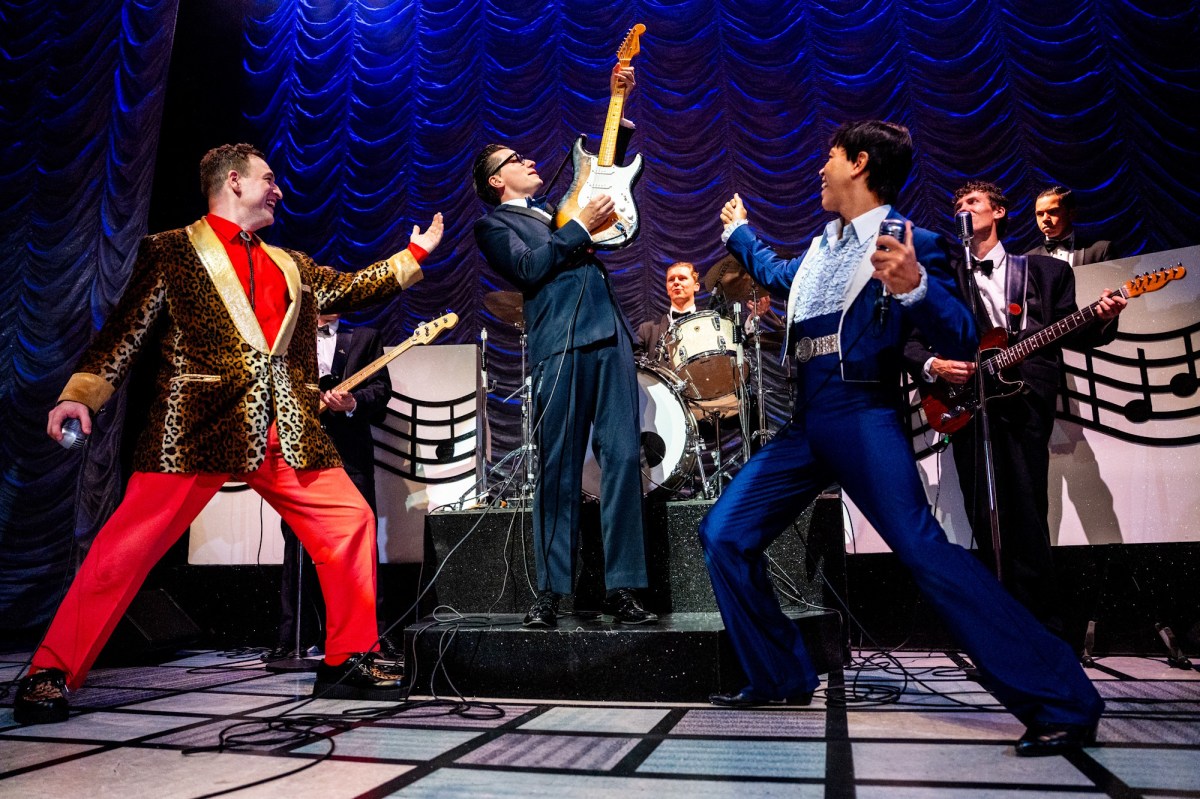
A more interesting challenge, and one the production cannot quite resolve, lies in the sheer abundance of Holly’s catalogue. His songwriting was prolific – with hits like Peggy Sue, That’ll Be the Day, Everyday and Heartbeat – and as the list of classics goes on, inevitably so does the running time.
Momentum flags under the weight of hit after hit, not because the songs falter, but because the dramaturgy struggles to accommodate so much strong material. It is a rare case of a musical wrestling with an embarrassment of riches rather than a shortage of them.
The Buddy Holly Story: foot-tapping enthusiasm
On this Bath opening night, the audience skewed noticeably older, many likely experiencing Holly’s songs as lived memory rather than inherited culture. Their enjoyment was evident: long before the theatre‑wide standing ovation, seats were bumping and jumping with persistent foot‑tapping.
This enthusiasm highlights the production’s reliance on nostalgia, revealing its vulnerability when it comes to reaching younger theatregoers. Buddy could be an ideal introduction for younger audiences to one of the most influential catalogues in early rock‘n’roll, but this staging appears content to play primarily to the faithful – a surprising limitation at a time when jukebox musicals have never been more dominant.
Buddy: The Buddy Holly Story remains a solid, good‑faith revival of a show built on extraordinary songs rather than extraordinary theatre. Its staging is tidy, its affection genuine, and its musical backbone as strong as ever – but its vintage is increasingly visible.
What lingers is the force of Holly’s catalogue, not the frame around it, and the question now is whether that frame can survive on the strength of nostalgia alone.