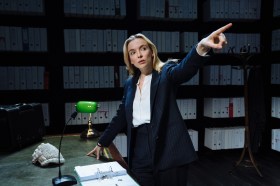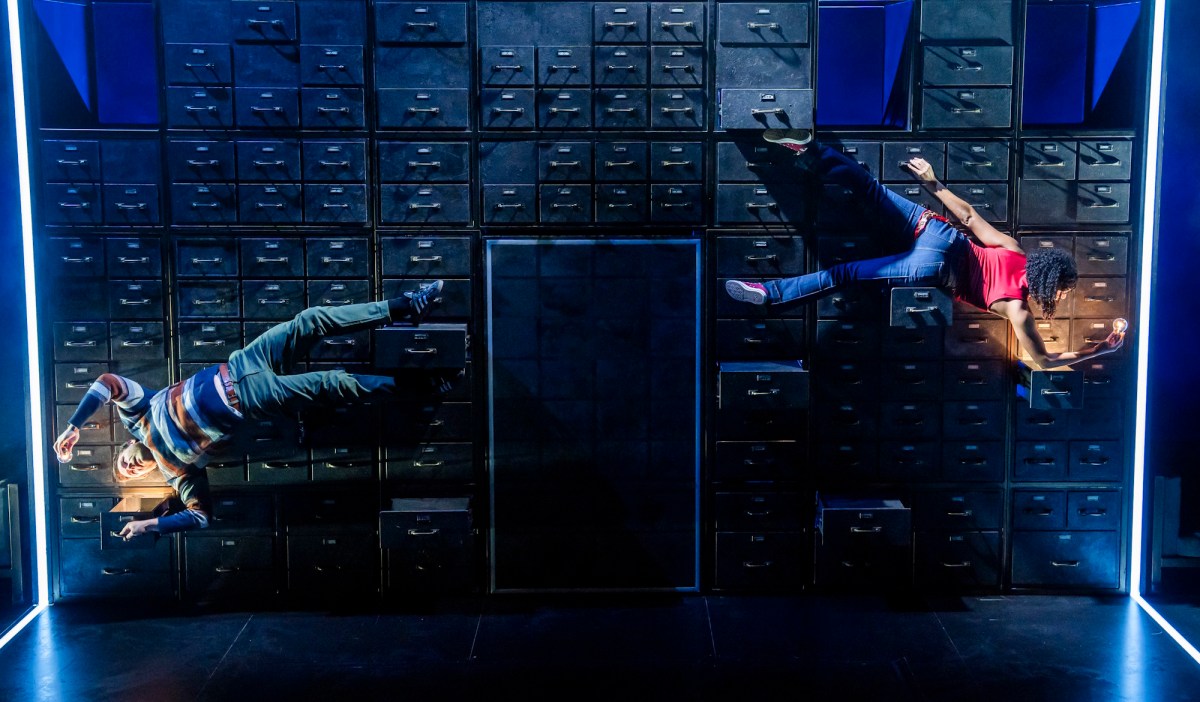
Imagine a bank vault for the psyche; a towering, monochromatic wall of filing cabinets where every drawer contains a light, a sound and a fragment of a fading life. This is the arresting visual landscape of Lost Atoms, a production that explores how we filter, store and eventually lose the people we love.
Directed by Scott Graham, this collaboration with playwright Anna Jordan moves beyond Frantic Assembly’s usual high-octane physicality to offer a study of the messy process of remembering.
The narrative charts the chronological arc of the relationship between Jess (Hannah Sinclair Robinson) and Robbie (Joe Layton) from a coffee-shop meet-cute to the eventual debris of betrayal and pain.
Lost Atoms review – quick links
Lost Atoms represents love and loss
Inspired by Alain de Botton’s Essays in Love, Lost Atoms is firmly embedded within the experience of love – partial, blinded, sometimes arrogant.
Jess and Robbie’s relationship is viewed as if through the rearview mirror, with the audience invited to play detective among the remnants of their shared life. This is a love that looks like a collection of data points: the specific way a partner breathes, the trivial argument that becomes monumental in hindsight, and the desperate, futile attempt to find a logic behind why two people who once fit together eventually fall apart.
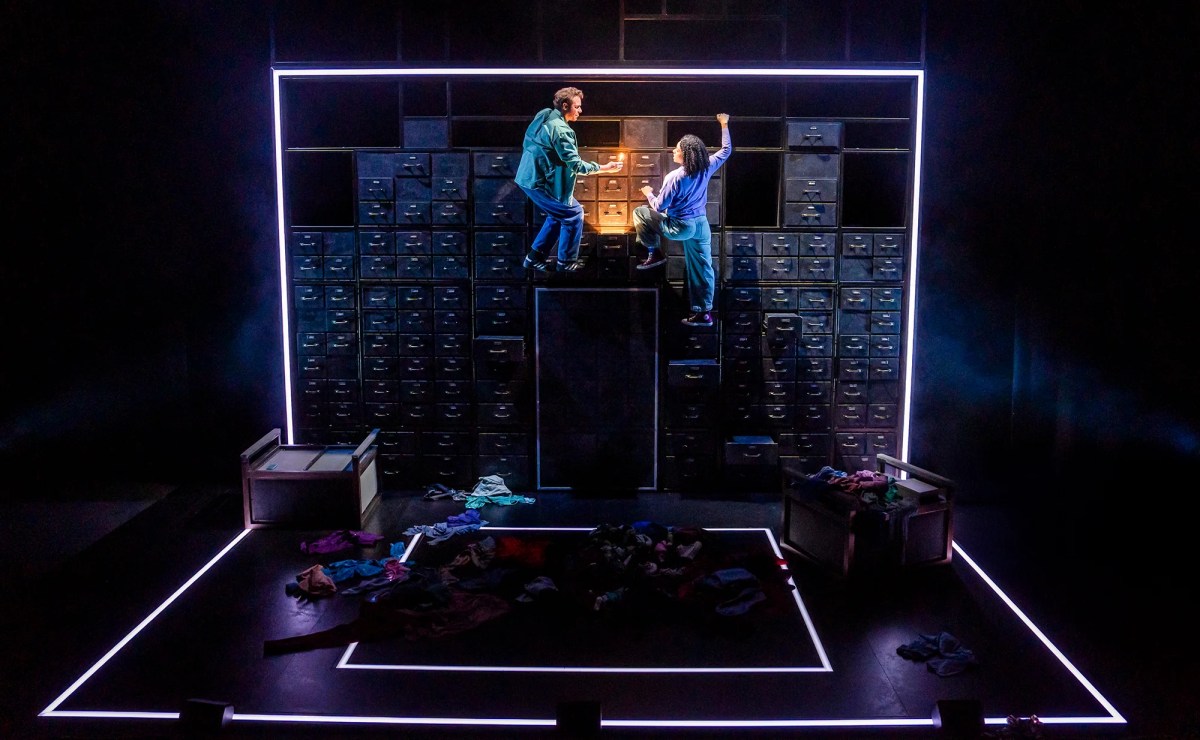
As a double-hander, the production’s impact is somewhat diluted by a persistent stylistic disconnect between the leads. Joe Layton’s Robbie is earnest, often stilted – an unvarnished honesty that grounds the play’s abstract leaps in a recognisable human ache.
In contrast, Hannah Sinclair Robinson’s Jess feels like a more laboured creation. While she possesses a formidable physical command, her delivery occasionally veers into an affectation that sits at odds with Layton’s naturalism. This friction in tone makes it difficult to fully buy into the early stages of their romance.
Inventive staging and physical performances
The production’s most consistent success is its visual architecture. Rather than a series of literal locales, Andrzej Goulding’s set serves as a muscular physical playground: a towering metal ‘memory vault’ of filing cabinets.
Here, drawers function as repositories for light sources that represent memories; fragments of a life that the characters can physically hold or, more devastatingly, watch as they burn out. The structure is pockmarked with gaps where drawers are missing – a haunting visual of memories already forgotten.
The vault also provides the vertical terrain for the company’s signature choreography, which remains their easy strength. There is a profound sensuality to Sinclair Robinson and Layton’s movement – a liquid, effortless flow that sees them traverse the cabinet walls as if gravity were merely a suggestion.
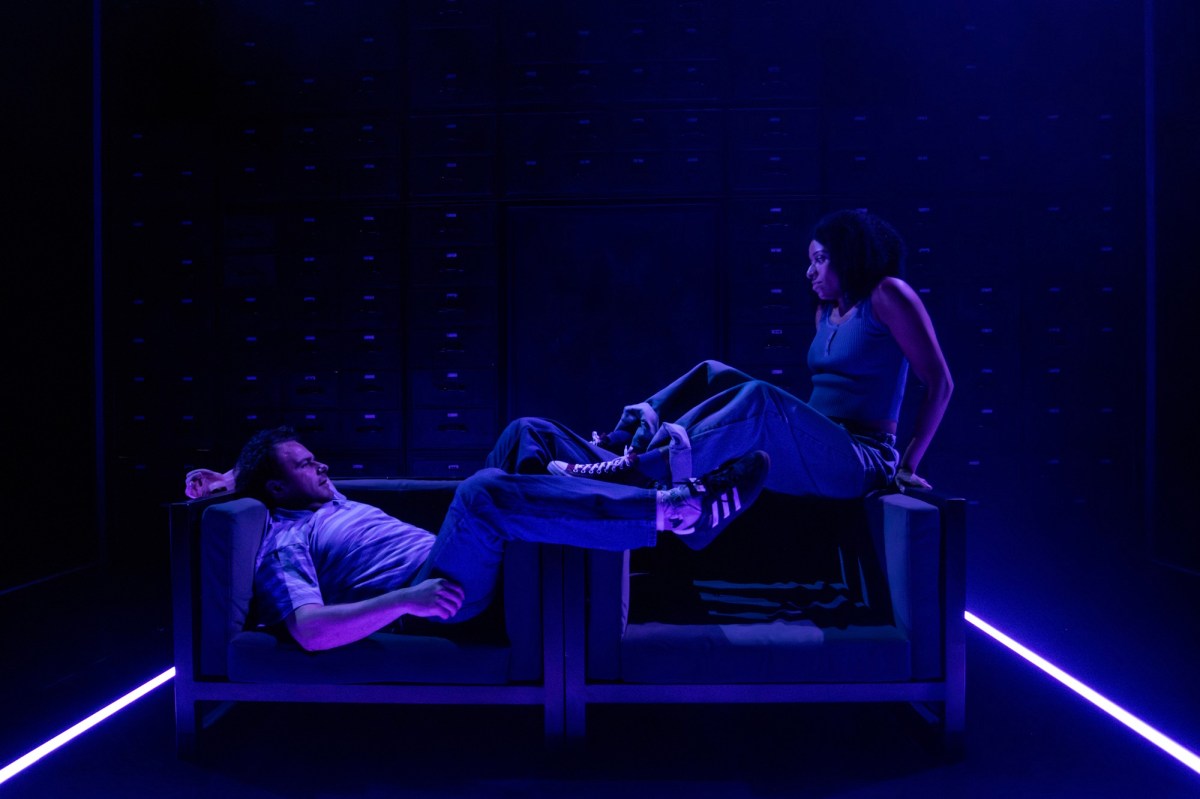
It’s in these wordless sequences that Lost Atoms finds its real heart. A drawbridge-like bed that unfolds from the wall, suspended in a dark precipice, becomes a stage for breathless intimacy that slows and then fractures into a laboured, painful effort to share the small space.
As the play moves toward its final beat, there are moments that lean toward the sanctimonious, trading its messy, gritty realness for a tone a touch too ‘lesson learned’. By attempting to wrap the narrative up in such a tidy package, it loses some of that unpolished, almost guttural truth that makes its best moments so potent.
In the end, Lost Atoms is a little like the relationship at its centre: moments of poignancy and beauty, yet ultimately defined by its disconnects.