The Wanderers is a thoughtful examination of modern American Jewishness from playwright Anna Ziegler of Photograph 51 fame, the hit play about DNA scientist Rosalind Franklin. It focuses on the lives of two couples, today’s Abe and Sophie and 1970s’ Schmuli and Esther; it’s not revealed until deep into the play that Schmuli and Esther are Abe’s (now deceased) parents.
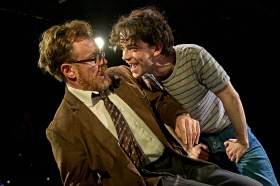
Abe is a stereotypical Brooklyn Jewish writer straight out of Woody Allen territory, brought to life here with some conviction by Alex Forsyth. He’s consistently annoying, with his ubiquitous headphones, the artistic arrogance of being a young Pulitzer Prize winner, and affected emotional helplessness.
Paksie Vernon is eminently believable as his long-suffering wife Sophie who just wants him to really ‘see’ her. Their relationship is challenged by Abe’s obsession with the glamorous movie star Julia Cheever, a role played by Katie Holmes in one of the US productions. Here it’s Anna Popplewell who is sleek and smooth and the perfect Jewish boy’s fantasy.
Abe admits this ‘makes me a bit of a cliché’ and he’s right! Unfortunately the clever conceit in this affair (and no, this is not a spoiler) rather undermines the script as piece of serious writing.
The Wanderers: real-life inspiration
Anna Ziegler says this part of the script was inspired by a real-life email exchange between actor Natalie Portman and novelist Jonathan Safran Foer that was published by the New York Times Style magazine in 2016. She says in the program notes ‘I was intrigued by the larger questions it raised – about how easily we create connections outside of marriage, sometimes through nothing more than words on a screen, and how powerful and destabilising that can be.’
Portman is to star in the new film adaptation of Photograph 51 coming out next year, a role played by Australian star Nicole Kidman in the West End ten years ago.
ArtsHub: Every Brilliant Thing review – Minnie Driver is ‘exceptionally good’
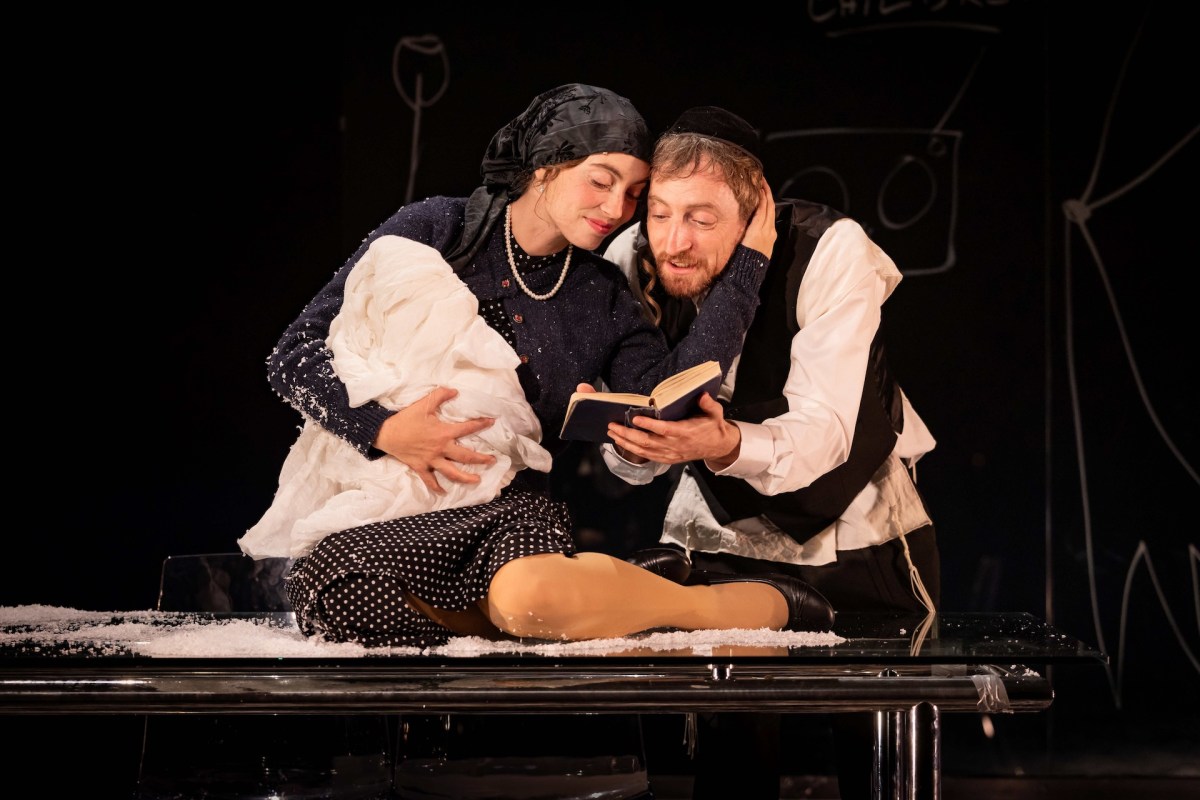
Their lives are contrasted with Abe’s parents, a couple paired in an arranged marriage and members of the conservative Hassidic community. Eddie Toll shines as Schmuli, a man ultimately torn between his family and his faith. His lines are sprinkled with Yiddish phrases – be sure to pick up a program for the handy cheat sheet on the back. Katerina Tannenbaum plays his wife Esther with impressive sensitivity and is fully believable as a woman who yearns for just a little more from life.
She’d love to get a job and (horror of horrors) take the newly-released contraceptive pill, but that’s all a step too far for Schmuli. Even raising these issues leads to heart-break for Esther.
Director Igor Golyak has chosen a pared-back set with a transparent screen centre-stage and confetti machines full of snow. The screen is used to good effect, sign-posting ‘chapters’ in the script and explaining characters and their relationships. (And full marks to the cast for learning how to write backwards!)
A long piece of white cloth is a key prop, doing duty as a bridal veil, a bed sheet, a tablecloth, and even a new-born baby. This works extremely well but other devices, such as the over-sized angel wings on Schmuli and Esther in spirit, the awkward string art making the Brooklyn Bridge, and the child’s voice reading Winnie-the-Pooh, are not so effective.
Overall, it’s a minimal set by designer Jan Papplebaum that rightly keeps our attention on the actors. There’s a haunting soundtrack by Anna Drubich and atmospheric lighting by Alex Musgrave; they both work well to complement the changing moods and heighten the play’s inner tension.
There is a lot to admire here, from its cautious examination of the rigours of life in a strict religious community, to a discussion about women’s rights, and a focus on what we want from life. There are themes of identity and belonging, of family ties, and the price of artistic ambition.
There are layers of meaning here, some probably more apparent to people with a deeper understanding of Judaism. The title itself, The Wanderers, talks to the Israelites’ 40 years wandering in the desert.
Somehow this play is less than the sum of its parts. It tries to say too much, and is so self-consciously clever, that it loses its sense of authenticity and emotionality. At its heart, The Wanderers asks ‘who really knows whether or not they’re happy?’ and for me, that fundamental question was the big take-away.
The Wanderers is at Marylebone Theatre to 29 November 2025.