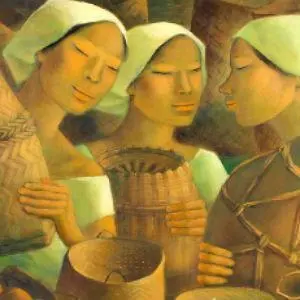
Anita Maysaysay-Ho was brought up surrounded by culture, having been born into a wealthy family before she married shipping magnate Robert Ho. She made history in 1999, when her work “In the Marketplace” was sold for P15 million at Christie’s in Singapore.
“Humility was the best lesson she taught us. She never measured her success in material things. She gave us inner confidence as she lived as a gentle spirit who felt her life was an offering to God,” her daughter, Doris Magsaysay-Ho said.
Not only was Anita recognized as a great Filipino painter, she also engaged in the art of poetry, once writing “Lord, how can I depict Thy work, without Thy hand in mine?”
Her painted works were a celebration of Filipino women, often depicting peasants engaging in their day-to-day activities such as winnowing rice, harvesting fruits and selling fish.
“In my works, I always celebrate the women of the Philippines. I regard them with deep admiration and they continue to inspire me – their movements and gestures, their expressions of happiness and frustration, their diligence and shortcomings, their joy of living. I know very well the strength, hard work and quiet dignity of Philippine women, for after all, I am one of them,” the artist once said.
Despite moving 45 times throughout her life, Anita’s work remained heavily focused on Filipino women. At age 13, she attended the UP School of Fine Arts accompanied by a nanny. Not only did she get to study alongside Botong Francisco, Vicente Manansala, Galo Ocampo and Cesar Legaspi, she was also privately tutored by the leading political cartoonist of the time, Ireneo Miranda.
After World War II, she was sent to study at the Art Students League of New York, where she met Robert Ho. The two were married in 1947, and had five children, followed by 14 grandchildren and five great grandchildren.
In 2002, Anita exhibited her work at the Crucible Gallery, which owner Sari Ortiga says was probably the biggest exhibition featured at the gallery.
“It took her a long time to finish one painting because she worked on each canvas layer after layer, waiting for each layer to dry up, in the traditional way. She did no shortcuts. There was one year she finished only two paintings, and she was working every day at that,” she said.
According to her daughter, Doris, Anita painted diligently every day from 9am to 5pm, and the pair often spent weekends together, painting portraits of their families and friends.
In 2009, the artist suffered a stroke, and stopped speaking. She did utter one last sentence, however, when she called her husband Robert and said: “Robert, you are the only man I ever loved in my life.” After that, Anita did not speak again.
She died peacefully last week, and was buried at the Capilla de la Virgen of Santuario de San Antonio in Forbes Park, Makati.
The artwork she has left behind is a remnant of the artist who was passionate about her country’s women, and who will always remain one of the greatest artists of the Philippines.