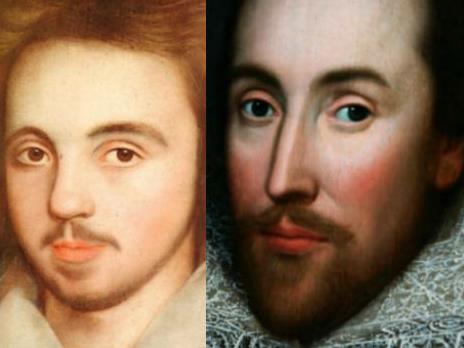
Marlowe’s name will sit alongside Shakespeare’s for the first three plays, Henry VI Parts I, II and III, in the next edition of the New Oxford Shakespeare published by Oxford University Press this month.
The three plays accredited to Marlowe are among 17 plays that will be given joint credit in the new edition. Other collaborators include Thomas Middleton, George Wilkins and John Fletcher.
Just a few months older than Shakespeare, Marlowe’s claim to equivalence with his now better known contemporary was cut short when he was killed in a tavern brawl in 1593 at the age of 29. Had Shakespeare died in the same year, he would have had only seven plays performed including the three now considered partially Marlowe’s. None of the tragedies was written until the 1600s.
In fact by the time Marlowe died not one of Shakespeare’s plays had a printed edition. The playwright himself was far from achieving popularity, having been famously lambasted by Robert Greene as ‘an up-start Crow, beautified with our feathers, that with his Tygers hart wrapt in a Players hyde, supposes he is as well able to bombast out a blanke verse as the best of you’.
Marlowe, on the other hand, had considerable acclaim in the late 14th century. He had published seven plays of his own by the time of his death as well as four volumes of poetry, and was mourned as ‘the Muse’s darling’ by George Peele, himself considered another collaborator of Shakespeare’s for his contribution to Titus Andronicus.
Marlowe’s hand in parts of the Henry VI plays has been suspected since the 18th century but the 2016 New Oxford marks the first prominent billing in an edition of Shakespeare’s collected works.
Professor Gary Taylor from Florida State University, who is among the lead researchers, told The Guardian that 23 scholars had used both traditional text analysis and 21st-century computerised tools to conclude that 17% of Shakespeare’s plays were, at least in part, collaborations. In the last edition in 1986 only eight plays were given joint title pages.
‘The orthodox view was that Shakespeare didn’t collaborate at all. When the Oxford Shakespeare in 1986 proposed that eight plays of Shakespeare contained writing by other writers, some people were outraged. What has happened since 1986 is that the accumulation of new scholarship, techniques and resources has made it clear that, in 1986, we underestimated the amount of Shakespeare’s work that’s collaborative,’ said Taylor.
Does it matter?
ArtsHub asked the Associate Director of Bell Shakespeare James Evans whether the revelations would make a difference to actors, directors and audiences.
‘Not all all. We have the words on the page. These attribution issues come up from time to time and whether it is dodgy stuff like the Earl of Oxford or interesting stuff, in the end people are coming to see a good story and wonderful characters,’ Evans answered.
He said modern audiences were very comfortable with the idea that Shakespeare had collaborators.
‘I’m not surprised by this because writing was a pretty collaborative art form back then and it still is. You look at TV writing and the writers’ rooms.
‘I think it’s quite exciting to look at the Henry VI‘s in this new light. Marlowe was born in the same year as Shakespeare but he got going a bit quicker and it’s interesting to see that he obviously gave Shakespeare a leg up when he got to London.’
But Evans said Shakespeare definitely outpaced his master. ‘If you look at some of Marlowe’s iambic pentameter he really drums it into you. Shakespeare was a bit more willing to toy with the form. He clearly learned what he could and moved on.’